Nov 25, 2026
20 min read
Mass atrocities don't commit themselves.
We know this.
We know it as surely as we know the crimes of Slobodan Milošević, of Rwandan Hutus, of Pol Pot, of the government of Myanmar, of Andrew Jackson and the Trail of Tears.
We know.
Hannah Arendt knew it too when she journeyed to Jerusalem to report on the trial of Adolf Eichmann for the New Yorker.
But knowing doesn’t make it any less difficult to sit with what is monstrous and what is familiar and to accept that they emanate from the same well of common humanity. Moisés Kaufman and Amanda Gronich, the co-playwrights of Here There Are Blueberries, now on Broadway, have pulled off something profound and generous: they have made it a little less difficult to reckon with what we know, and face what is true.
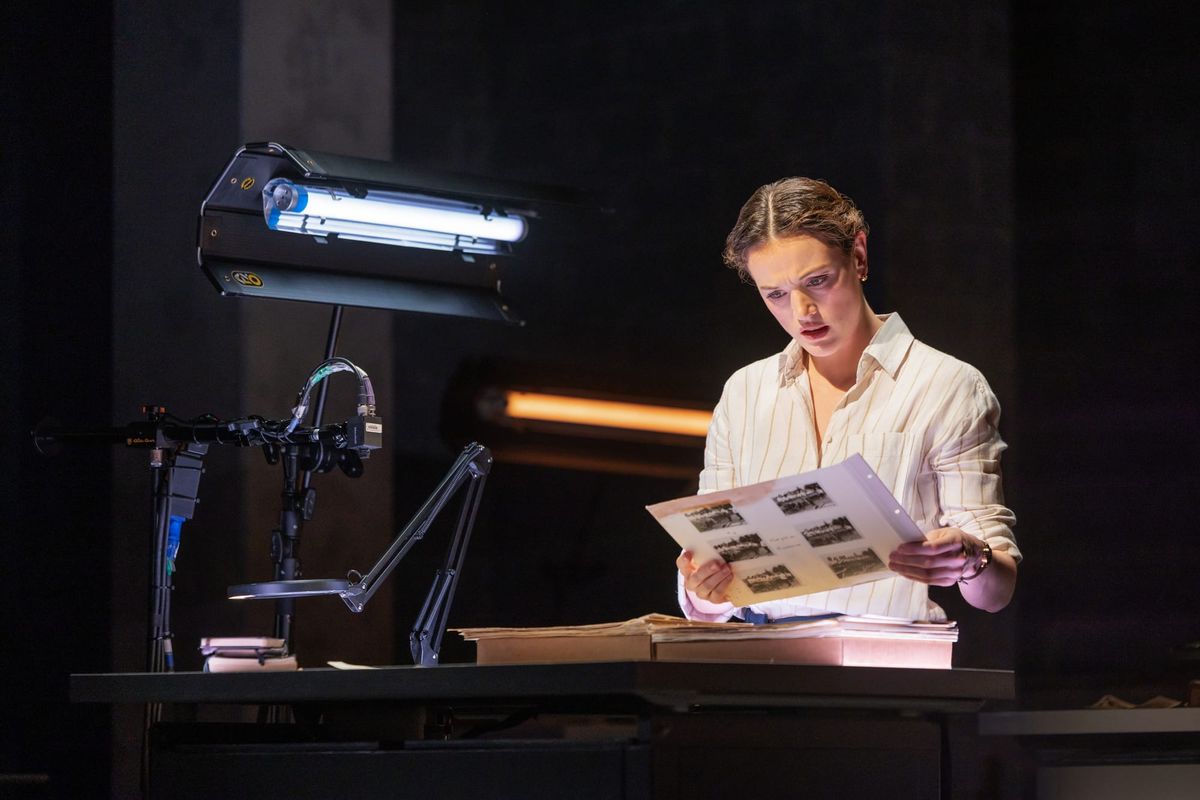
Here There Are Blueberries is a play about framing, narrative, memory, shame, and complicity. It is a play about photography and the doubled nature of existence. Its central character is a museum archivist.
It is riveting.
Conceived and directed by Kaufman, Here There Are Blueberries, a 2024 finalist for the Pulitzer Prize, opened on Broadway November 9 after a world premiere in July 2022 at the La Jolla Playhouse. (In 2024, it premiered off-Broadway at New York Theatre Workshop.) It is not a documentary play—a verbatim transcript of conversation and action—like The Laramie Project, Kaufman’s best known work. He incubated both at Tectonic Theater Project, his developmental company. However, all of the photographs used, and the people identified in them are real. They made news when their discovery was publicized in 2007. The text is based on interviews conducted with those involved, along with historical transcripts and other primary source material.
Here There Are Blueberries takes its name from a photo album belonging to Karl Höcker, a Nazi administrative assistant to the final commandant of Auschwitz, Richard Baer. An anonymous retired U.S. lieutenant colonel found it in 1946. Decades later, he wrote to Rebecca Erbelding, an archivist for the U.S. Holocaust Memorial Museum, an institution dedicated to preserving the memories and experiences of victims. The play unravels mysteries behind the subjects of the album.
The album was an anomaly within an anomaly. The photographs were not of the camp’s prisoners, but the officers and staff who oversaw it. There are vanishingly few photographs from Auschwitz, period, and even fewer of Nazi life there, because once it was clear that they were losing the war and would be caught, such evidence was largely destroyed. The information they held told a parallel story to the museum’s stated mission.
Prior to the war, Höcker was unremarkable. He’d been an accountant and a bank teller in Germany. He joined the SS in 1933 and was sent to the front, where he sustained an injury. The Nazis reassigned the recovering Höcker to Auschwitz, a 15-square-mile site in Poland that included a forced labor camp, killing factories and crematoria, and a bucolic riverside chalet called Solahütte. The Nazis used the chalet to reward their ranks with respite. There, SS officers socialized with Helferinennen, young women who performed administrative work, and who had been raised to be ideal Aryan specimens who would marry SS officers and give birth to future generations of the Reich’s Aryan elite.
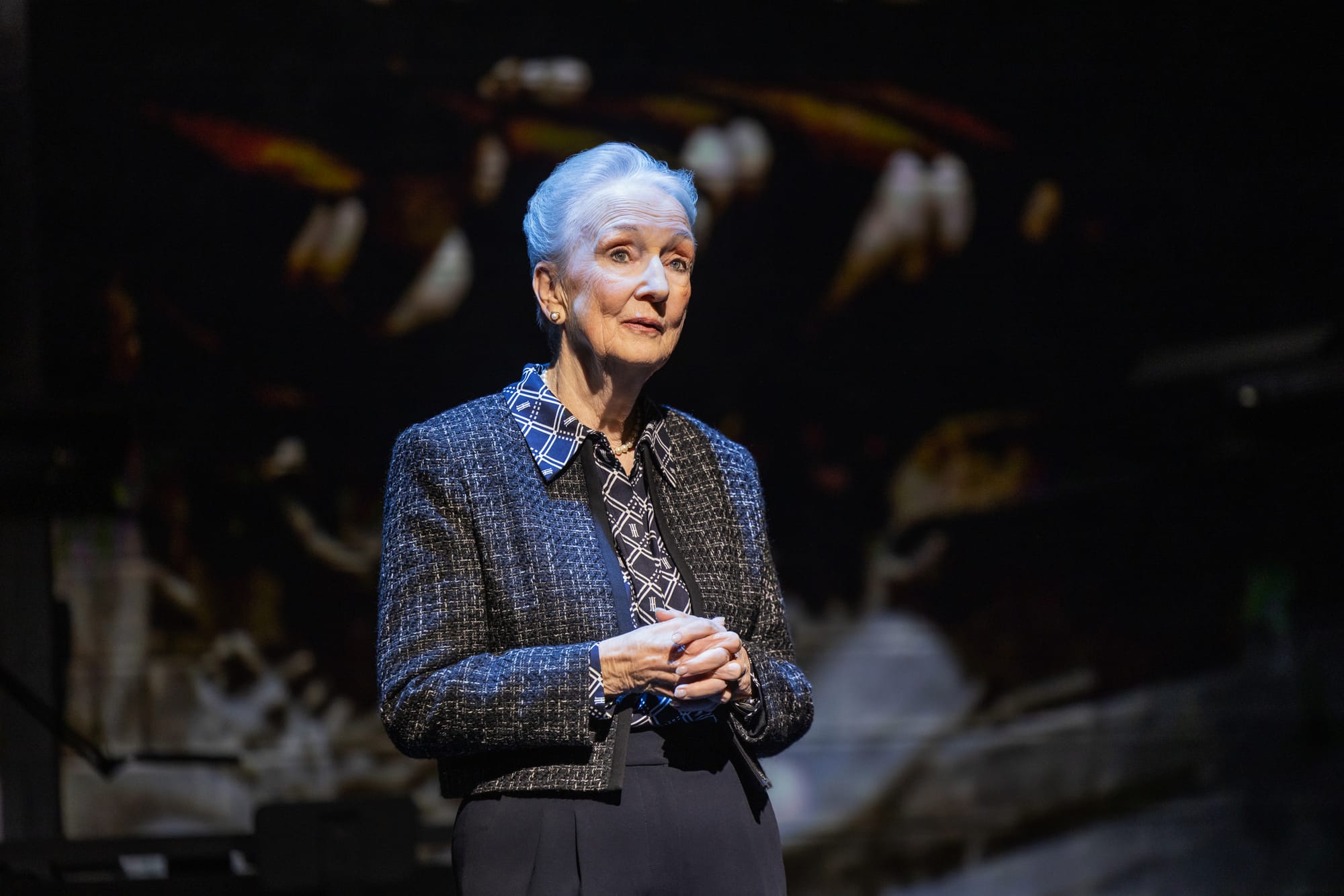
There were blueberry bushes at Solahütte. We know because Höcker photographed the Helferinnen eating their fruit. When Erbelding and her boss, Judy Cohen (Kathleen Chalfant, comfortably dwelling in equilibrium between approachable and soigné), begin to contextualize the blueberry photos, an audible shockwave passes through the audience.
JUDY. It’s these blueberry photos that make the album
notorious. Just the fact that there were young women
there. And people didn’t know that. People didn’t
understand why they would be there. And I think there
is some sort of Puritanical shock that women were
involved. That they participated in the factory nature
of Auschwitz.
REBECCA. People called us and said, “These people look
normal. The girls look like teenage girls.” Because they
were. And that was surprising, that they look like us!
One caller even said, “I know I never could’ve been a
Mengele. I know I never could’ve been a Höcker. But
could I have been a Helferin?”
Here There Are Blueberries is extraordinary because of the humane insight of Kaufman and Gronich in their choice to address two challenges simultaneously. The first is in answering fraught, but valuable questions: Why bother investigating, much less displaying, the contents of a photo album that appears to document what a lovely, normal-seeming time SS officers had while stationed at Auschwitz? While they took respite from their day jobs of mass murder at a vacation lodge on the Sola River, just two miles from Birkenau? While they held cheery Christmas celebrations in December 1944 as Soviet forces advanced toward them?
Why bother immersing oneself and others in these profane realities, with the imprimatur of a museum dedicated to the memory of the Nazis’ victims? What value could we possibly draw from them?
Arendt’s final line to Eichmann in Jerusalem did not offer a satisfying answer to this question because that was not her assignment. Readers resented her for it. What she did was capture Eichmann’s stubborn, maddening, self-centered vacuity: “It was as though in those last minutes he was summing up the lesson that this long course in human wickedness had taught us—the lesson of the fearsome, word-and-thought-defying banality of evil.”
Here There Are Blueberries however, does offer an answer, by way of Judy and a deft bit of pedagogy in media literacy and theory:
Every photograph is the result of a double crop.
The first crop is the point in time that’s recorded in the
photo. And you have no idea what happened even five
seconds before the photo was snapped or five seconds
afterwards.
The second crop is the decision the photographer
makes about what’s in the frame and what’s outside the
frame. We don’t see what’s left outside the frame.
We think we know what’s left outside of Höcker’s frame: industrialized starvation, illness, torture, and death. But still more remains unseen: descendants and the weight they carry, of secrets, of survival, of incomplete knowledge, of unresolved grief and shame. Another question emerges: how do we reconcile these adjacent realities, their implications, and the way they continue to follow us into the present?
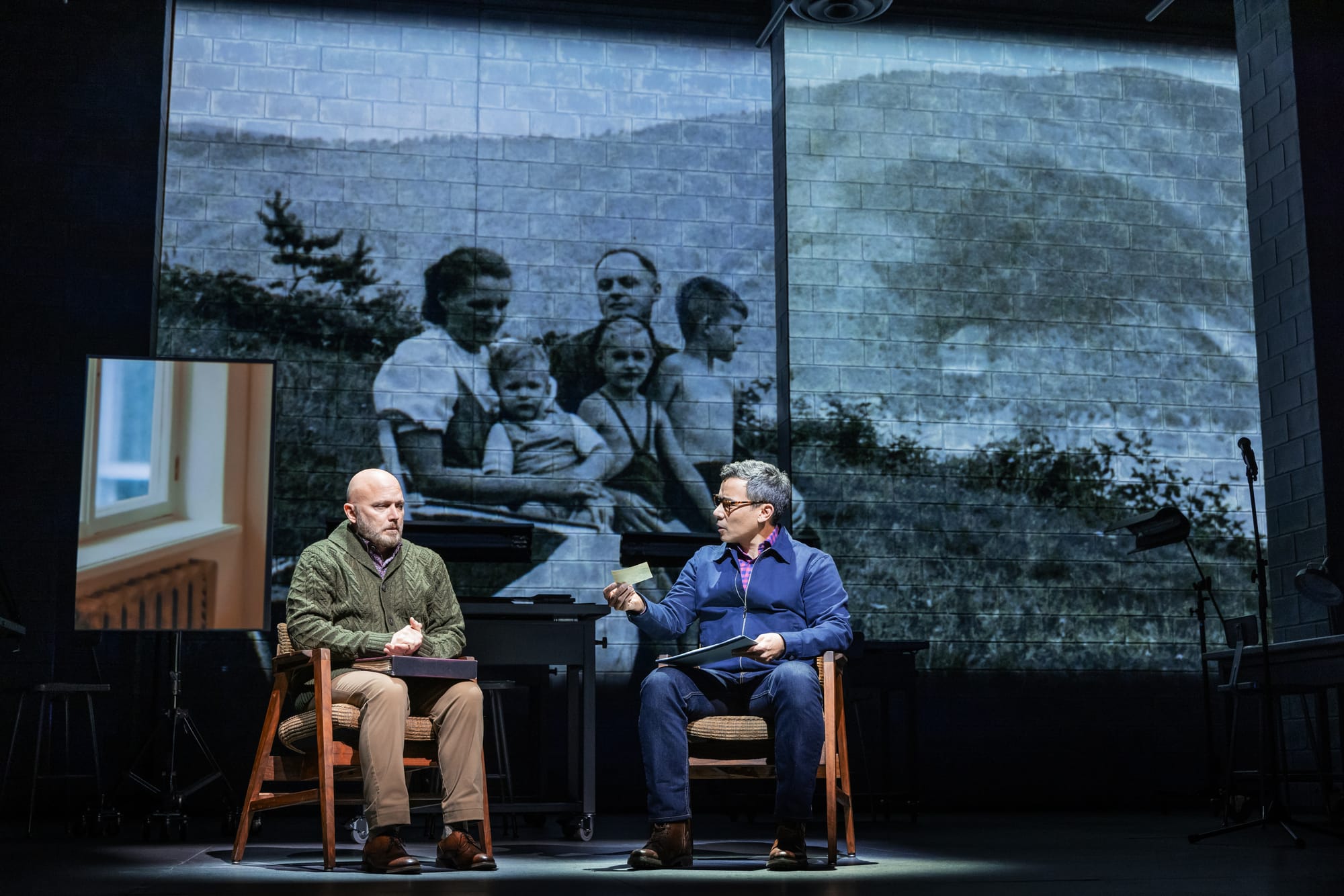
After the Holocaust Memorial Museum authenticated the Höcker album and published all 116 of its photos on its website, the museum began to receive new information, not just from victims and their descendants, but the descendants of perpetrators as well. The first to come forward was Tilman Taube (a heart-shattering Conrad Ricamora), who saw the photos in news stories and recognized his own grandfather—a person he knew.
The discovery roiled Taube. There was a generation of children who had grown up during the war whose relatives were party to a bureaucratized machinery of mass death. Taube knew there were other descendants who were just as roiled, their psyches just as haunted, by the fact that people and places that they’d associated with innocence, joy, and love, especially as children, had participated in a genocide. What were they to do with this knowledge as adults? How were they to reckon with these sickening revelations of harm caused by their parents and grandparents? How would they attempt to differentiate themselves while offering repentance and repair? How and where could they discuss these things? Why not simply consign those ancestors to a memory hole and move on?
“Those who say nothing…they transfer this trauma to the next generation,” Taube says.
Director Daniela Völker attempted to address such questions in the 2024 documentary The Commandant’s Shadow. The film captures a meeting between Anita Lasker-Wallfisch, a survivor who was spared from the gas chambers because she played cello in the Women’s Orchestra of Auschwitz, and Hans-Jürgen Höss, son of the notorious commandant Rudolf Höss, who designed Auschwitz. (Director Jonathan Glazer dramatized the life of Hans-Jürgen and his family in the 2023 Oscar-winning drama The Zone of Interest.)
Völker engages a second generation too, the children of Lasker-Wallfisch and Höss, revealing the extent to which their lives are shaped by the experiences of their parents and grandparents. The trauma and its debts are intergenerational and inescapable. For descendants of both victims and perpetrators, silence does not vacate trauma or guilt. It gives it a place to fester and propagate.
“My task now is to clarify what exactly my grandfather was involved in,” Taube says when he decides to make his grandfather’s identity public. “My parents’ generation didn’t talk about this. My generation must be different.”
Instead of engaging in a fruitless attempt to rewrite or paper over the past, Taube finds power and agency in his ability to shape the future.
Here There Are Blueberries would be a strong, affecting work if it only tackled this one uncomfortable juxtaposition. But the second challenge it meets—the task of addressing a crisis of credibility endemic to our contemporary era—is equally important. This challenge is existential. An inability to reach a common understanding of objective truth impedes self-awareness and the will to make different, less catastrophically violent choices. How can people have a conversation, much less engage in negotiation, if they cannot agree on what is true?
“The ideal subject of totalitarian rule is not the convinced Nazi or the convinced Communist, but people for whom the distinction between fact and fiction (i.e., the reality of experience) and the distinction between true and false (i.e., the standards of thought) no longer exist,” Arendt wrote in The Origins of Totalitarianism (1951).
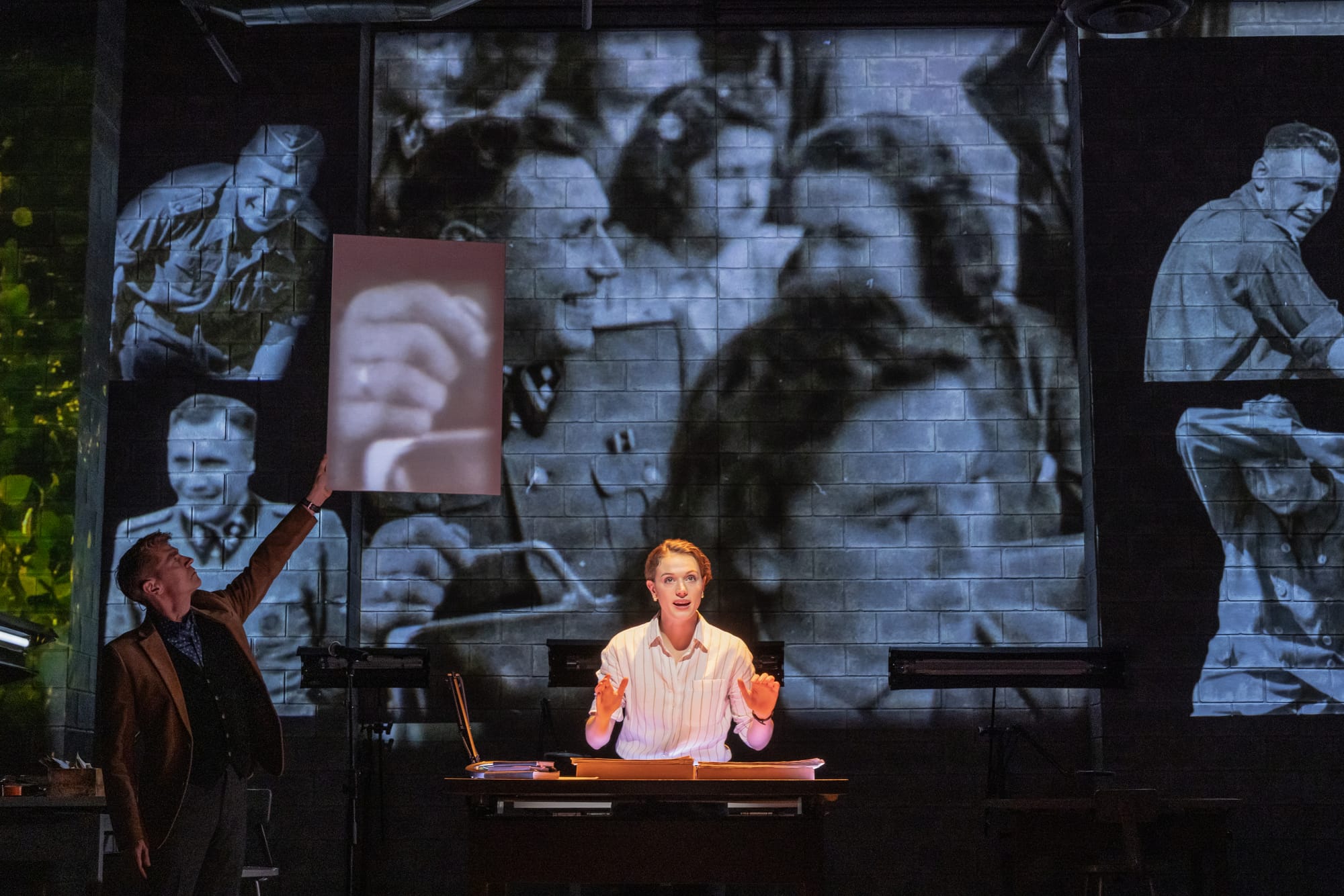
By enlisting Erbelding as a trusted expert who addresses the audience directly and guides us through her experiences using the methods that she and her colleagues depend on to discern what is true, the play invites us to witness parts of institutional decision-making that typically remain unseen and unexplained. Obscuring those processes can make institutions vulnerable to the cynical speculation of mobs whipped up by the poisonous sophistry of “just asking questions,” and the scale and speed with which the internet now rewards such bad-faith muddling.
This transparency is the narrative equivalent of showing one’s work when solving a math problem. Onstage, it offers an astute artistic response to a crisis of mistrust. As Erbelding, Delia Cunningham leads the story with an almost preternatural sense of patience and control in her Broadway debut. She draws you in to Erbelding’s sense of curiosity and care, her inability to let a mystery go unsolved.
Kaufman and Gronich’s choices, which make transparency, process, and universality the stars of the play, suffuse the entire production with humility and openness. Scenic designer Derek McClane’s choices of simple steel drafting and light tables and stools, flanked by concrete columns evoking the architecture of the museum, advance the same goal, inviting us to join Erbelding at work as she journeys into Höcker’s work life and the monstrous familiarities he documented—familiarities that continue to reach decades into the future.
There’s a commonality running through the nonfiction work I’ve found most engaging and memorable this year, a list that includes Here There Are Blueberries, You Can See Everything, and NAZA. All are responses to a polycrisis of credibility, trust, and epistemic collapse. They demand contemplation and discussion, and in doing so, help repair attention spans and relationships clipped by the siren call of the endless scroll.
When I interviewed documentary filmmaker Raoul Peck (I Am Not Your Negro, Exterminate All the Brutes) in 2017, he was furious and impatient with the American public’s habit of using reality television—the very medium from which our would-be autocrat had sprung—as an escapist analgesic. It had broken containment. The Potemkin emptiness that characterized “reality” television was now “reality” governance.
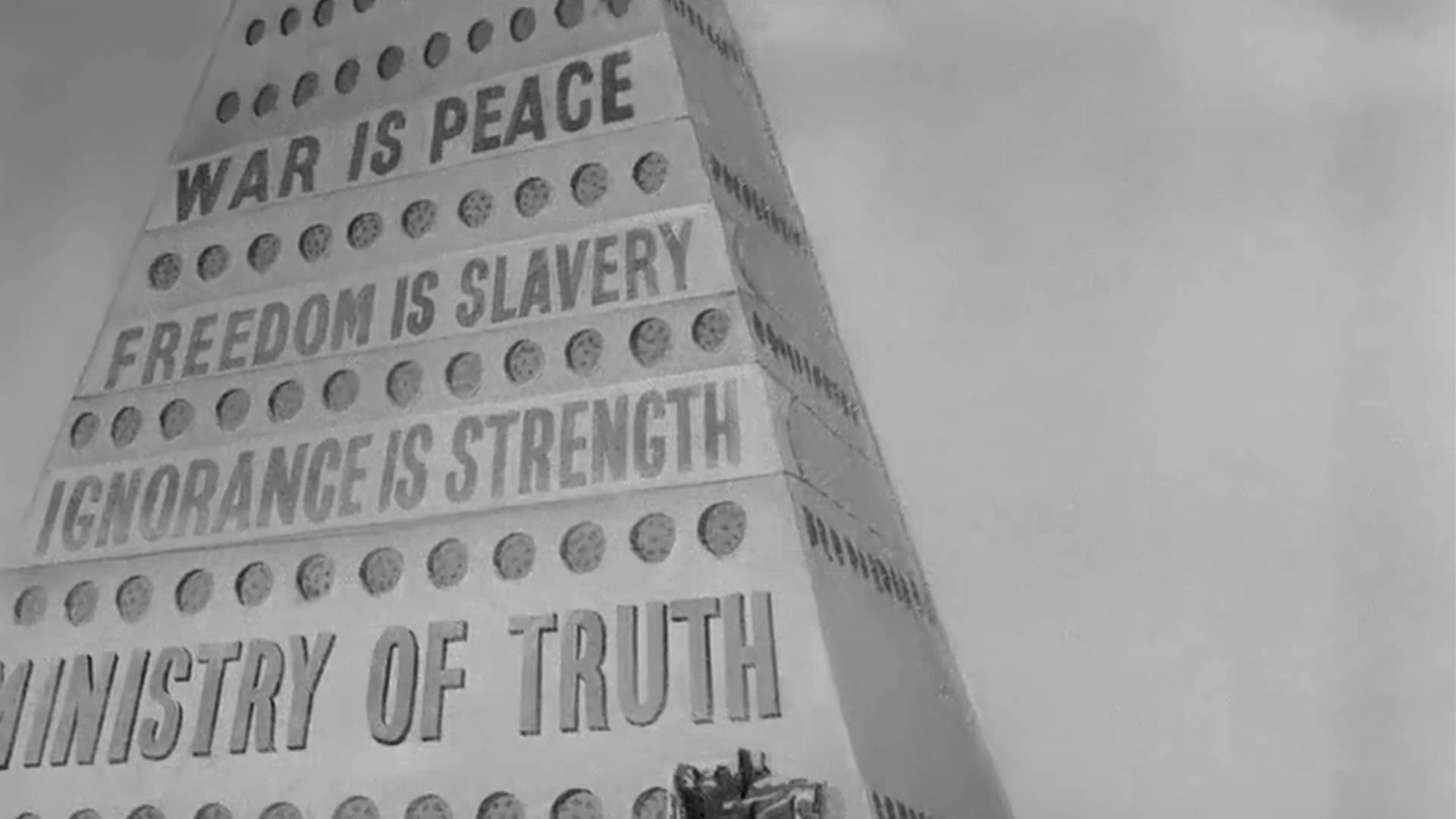
In 2025, Peck returned with another fiery documentary: Orwell: 2+2=5. He paired the words of George Orwell, whose 1984 reappeared on bestseller lists at the Trump era’s dawn, with images from a library of dystopian films including Minority Report and M3GAN. When I spoke to Peck about it last August, the megalomaniac technologist Elon Musk was tearing through the federal government, aided by a cult of AI-wielding manchildren doing his DOGE bidding. The White House still had an East Wing.
“It’s zero to midnight,” he warned.
The early part of the Trump era was rife with cultural indicators doubling as warning klaxons. The artist Hank Willis Thomas constructed a “Truth Booth” and toured it around the United States. The Origins of Totalitarianism summited the New York Times nonfiction bestseller list. Programmers of film festivals, theatre, and television frequently dug in the crates for classics that spoke to the moment. The Kennedy Center played host to a national touring production of Cabaret. The Public mounted a revival of A Bright Room Called Day. Michael B. Jordan starred in an adaptation of Fahrenheit 451. In 2022, Merriam-Webster chose “gaslighting” as its word of the year. By 2026, we’d transitioned from the Atwoodian hellscape of The Handmaid’s Tale to its next generation sequel, The Testaments.
There was a grinding, hair-on-fire obviousness to much of the work. It was timely. “Important” and “urgent” enjoyed a lot of mileage as descriptors. Early Trump-era pop culture largely concerned itself with mirroring the scat-poisoned zone of interest in which we found ourselves, or imagining how much worse it could get.
In Here There Are Blueberries and You Can See Everything, I see artistic evolution responding to a decade overwhelmed with bad faith and false binaries. This work deliberately leaves space for viewers to engage critically and think for themselves, the very element Peck has been evangelizing for years.
Sign up for Soraya [dot] Press
culture | criticism, commentary & reporting from Soraya Nadia McDonald
No spam. Unsubscribe anytime.
AI deepfakes have provided scammers and would-be information poisoners with sophisticated tools, making it even more difficult to trust that the images we encounter, especially on social media, where Americans increasingly get their news, are real. The NBC comedy The Fall and Rise of Reggie Dinkins stars Daniel Radcliffe as a disgraced documentary filmmaker following the show’s disgraced titular character, played by Tracy Morgan. The current season features Craig Robinson as Reggie’s nemesis, Jerry Basmati, and it includes a running gag: Whenever cameras record Basmati doing something untoward, he attempts to create plausible deniability by twisting or warping his fingers to make the images appear AI-generated.
A less trustworthy information environment is shaping the way storytellers make things and how viewers respond to them. Alex Gibney (MUSK) and Ava DuVernay (14th) have encountered pushback and ethical scrutiny over their choices to use AI in their most recent documentaries, despite years spent building reputations as credible filmmakers.
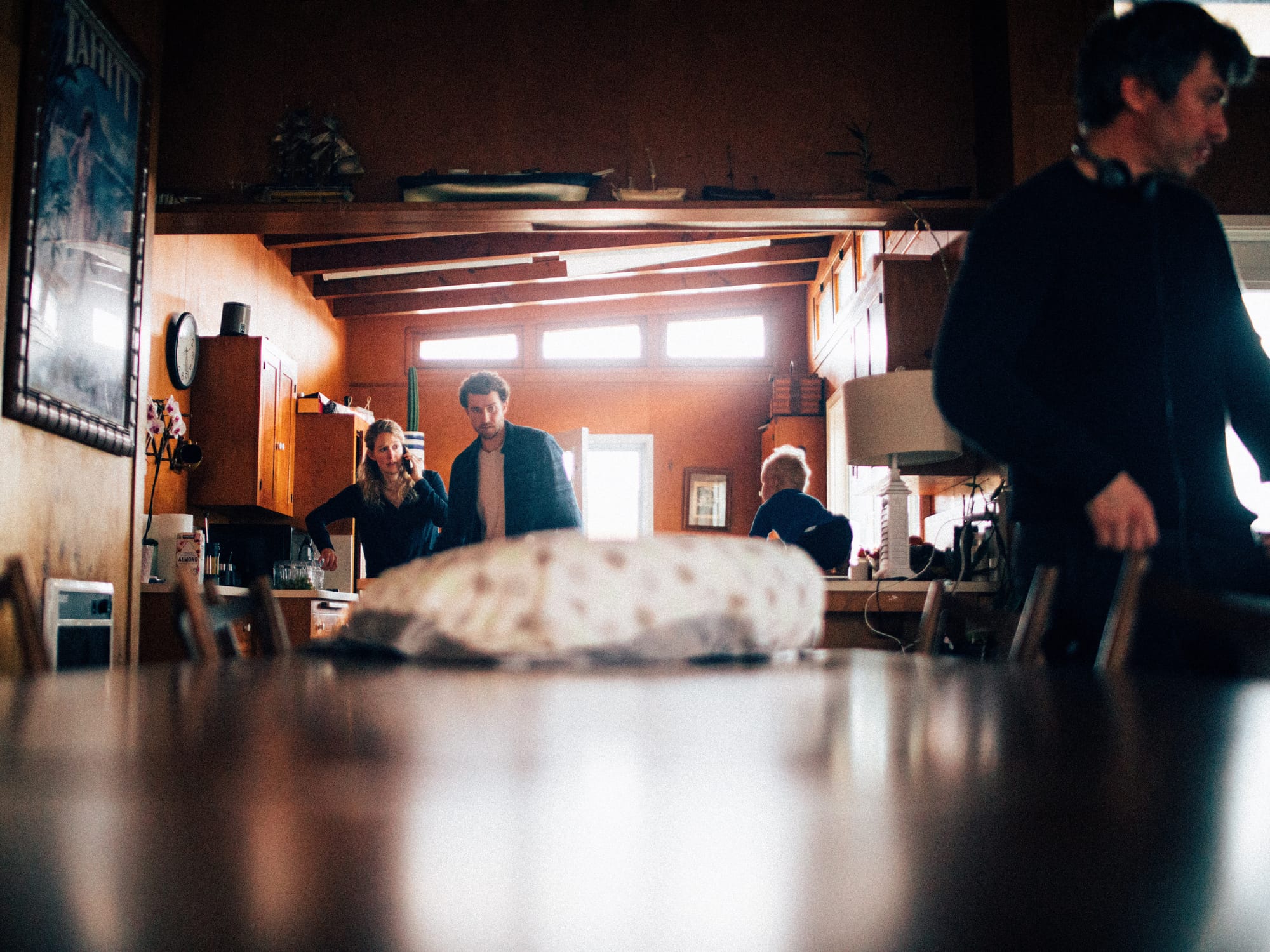
You Can See Everything, which debuted at this year’s New York Film Festival, deliberately dances on the fault lines and ethics in an attempt to capture and reflect the unreliability of its subjects, Theranos founder and convicted fraudster Elizabeth Holmes and her partner, Billy Evans.
Co-directors Nathan Fielder and Lance Oppenheim have bottled the sensation of witnessing oneself slip into the quicksand of another's mendacity into a three-hour metadocudrama.
Their choices include enlisting Amanda Seyfried, who won an Emmy for playing Holmes in the narrative Hulu miniseries The Dropout, to reprise the role in reenactments of real interactions Fielder had with Holmes that he was unable to film. Like A Current Affair, but arthouse.
The metadoc gets even stranger as Fielder and Seyfried (no longer in character) talk to each other about Holmes in their search for what’s true. It's the sensation of perceiving yourself, a rational person, begin to question if you're nuts and perhaps 2+2 has equaled 5 this whole time—even if you know better than to fall for that math problem and her white woman tears!
Oppenheim is now the subject of an ethical controversy regarding a short film he sold to the New York Times in 2017. Holmes, originally sentenced to 11 years and three months in federal prison, has reportedly been approved for a transfer to a halfway house next August.
You Can See Everything’s depiction of the Evans, Holmes, and their wobbling attempts to manufacture reality prompted Mary Harris, host of Slate’s What Next podcast to query, “Does the open grappling with what is true make this film more honest?”
This is not a new question, but it does feel newly relevant. In 1968, the avant garde documentary filmmaker William Greaves was inspired by the conundrum of Heisenberg’s Uncertainty Principle, which posits that it’s impossible to observe a system without changing it. The result of wrestling with this dilemma was Simbiopsychotaxiplasm: Take One (1971) and Simbiopsychotaxiplasm: Take 2 ½ (2005). Both feature Greaves attempting to direct a narrative feature in New York’s Central Park, while enlisting a second film crew to document the making of the narrative film, while also showing the way passersby interacted with both, and what these uncontrolled elements brought to the story and what it was saying.
Here There Are Blueberries and You Can See Everything share a baseline formal humility. Neither expects the audience to believe the story simply because it is being presented to them—the credulous passivity that has so long been a source of irritation for Peck. These two works recognize credibility as a currency that must be earned, and part of the art is in acknowledging and incorporating that factor of skepticism and disbelief.
Then there’s NAZA.
Here There Are Blueberries uses critical engagement with media to demonstrate the degree to which humans can dissociate from their roles in administering murder to revel in something as innocent and ordinary as flirtation and fresh fruit. It trusts audiences to see that the banality that grows out of the professionalization and bureaucratization of killing is not a darkness unique to the Nazis.
Its subtext of universality now evokes an ugly, uncomfortable, and unavoidable doppelganger: Israel’s three-year-long vengeance campaign of bombardment, starvation, and genocide in the Gaza Strip.
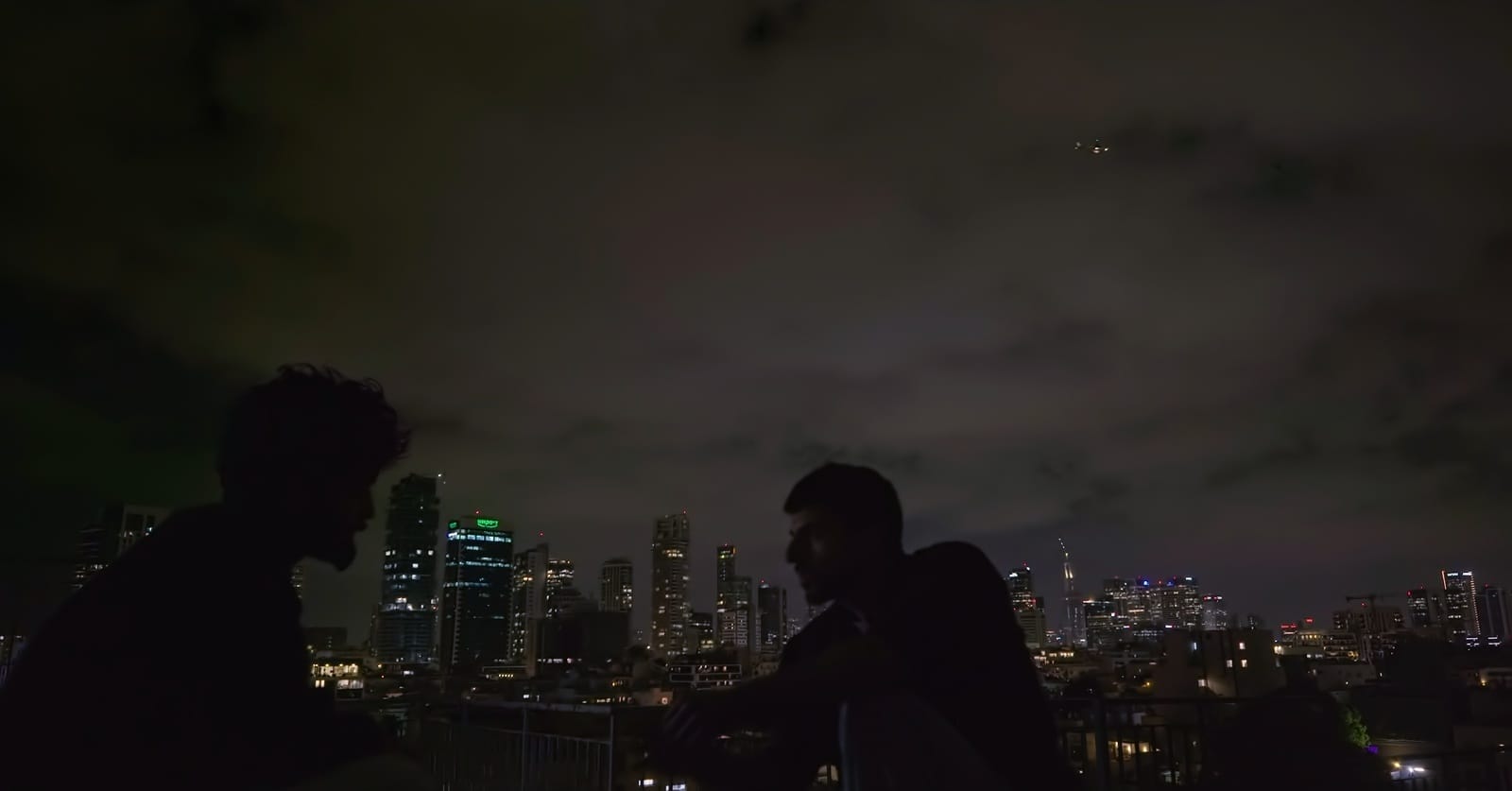
NAZA, from Rachel Szor and Yuval Abraham, the Oscar-winning co-directors of No Other Land, uses nighttime interviews with 24 anonymous Israeli military intelligence officers of varying rank and responsibility to document the banality of an ongoing AI-assisted atrocity. It premiered September 10 at the Venice Film Festival, where it received a 25-minute standing ovation and won a Special Jury Prize.
Abraham can be seen as he engages his silhouetted interview subjects, members of the elite 8200 unit on the rooftops of a wholly modern Tel Aviv filled with skyscrapers. Early in the film, a software developer who describes himself as a “small cog” explains how the military uses AI software, including one called Lavender, and what it does. As NAZA progresses, the involvement and actions described by its subjects escalate. The officers speak in frank, conversational tones about using Lavender to locate Hamas militants remotely and give orders to attack them with bombs or drones. These attacks would often take place at night when targets were at home with their families. “NAZA” comes from the Hebrew shorthand for collateral damage, “nezek agavi.”
Gaza is home to two million people. In response to an October 7, 2023 Hamas attack that left 1,195 Israelis dead and saw 251 kidnapped to Gaza as hostages, prime minister Benjamin Netanyahu authorized a “complete siege" of the Gaza Strip. As of October 2026, Israel has killed approximately 74,000 Palestinians, including 21,000 children, according to the Gaza Health Ministry.
Gaza has been rendered into a gray, rubble-filled wasteland of constant surveillance and isolation, cut off from the rest of the world by Israel’s 16-year blockade. The Israeli government continues to bar foreign reporters from independent access, has “systematically destroyed media infrastructure,” according to the Committee to Protect Journalists, and has killed more journalists than any other military since CPJ began tracking such data in 1992. Israel disputes this and claims some killed were militants posing as media workers.
The film explains how Israel has blanketed Gaza with surveillance since the earliest days of occupation. Every house, every building, every family, and every person is cataloged. Intelligence officers are able to hack the phones of anyone in Gaza, read their messages, and listen to their conversations because Israel controls all of Gaza’s telecommunications infrastructure. They can eavesdrop through a person’s phone and listen to them wail after a bomb has killed someone close to them, an experience multiple officers in NAZA describe.
“Everyone has an IDF serial number,” explains one interviewee.
The film is full of anecdotes that speak to the systematized, dehumanized nature of the killing taking place.
“All I can say is we’re completing the mission. That’s the mission,” says one operative.
“We became experts at burning houses,” says another, recalling that “destroying houses for the sake of destruction was done on a daily basis.”
“My role is technical. I’m not supposed to express any moral or principled position.”
“The goal in bombing private homes was ‘quantity, not quality.’”
“It’s so insanely fun. It’s fun. It’s mission-driven.”
“Whoever you decided to kill was considered a terrorist.”
In September, following NAZA’s premiere, Netanyahu threatened to pass laws that would revoke Abraham and Szor’s Israeli citizenship. He lost his governing majority in parliamentary elections the following month. Opposition leader Gadi Eisenkot has until December 6 to form a coalition government.
The details divulged by members of the 8200 unit has captured most of the attention NAZA has garnered. But the film also offers a conscientious critique of Israeli news media. Abraham and Szor visually punctuate their interviews with nighttime footage of Israelis going about their normal lives, observing them meditating, watching television, reading. What’s especially noticeable is the ubiquity of flatscreen televisions when the directors capture a city of people tuned in to the same news channels, listening to the same talking points from their leaders, talking points NAZA’s interviewees directly contradict. At one point of memorable irony, the camera pans over a cinema in Tel Aviv commemorating Claude Lanzmann and Shoah, his epic documentary of first-person interviews about the Holocaust.
+972, the magazine that published Abraham’s reporting and co-produced NAZA with The Guardian and Local Call, recently published an investigation into an ongoing disinformation campaign targeting the documentary. Its apparent goal is confusing search engine and chatbot users by conflating the film made by Szor and Abraham with a right-wing counter documentary with a similar name.
Perhaps the single most damning testimony Abraham and Szor record in NAZA is that of an intelligence officer who says, “Before, I asked myself how Germans could live with themselves. Today I understand it.”
“Do you think it’s a genocide?” Abraham asks.
“Yes,” he responds. “Absolutely.”
“Do you believe you participated in a genocide?” Abraham follows up.
“Yes,” the anonymous officer replies. “We have to describe things as they are.”
In his 2006 introduction to Eichmann in Jerusalem, entitled The Excommunication of Hannah Arendt, Amos Elon wrote:
“[Arendt] became more and more disillusioned with official Zionist policy in Palestine because of its failure to achieve a peaceful modus vivendi with the Arab population. She foresaw the spread of religious and nationalist fundamentalism among Israelis. These warnings seemed at the time as provocative as her book on the Eichmann trial. She argued on both moral and pragmatic grounds, insisting that Israelis must share power and/or territory with Palestinian Arabs. In retrospect, her warnings displayed considerable foresight.
Today’s readers may be more willing to accept both her essays and her book on Eichmann on their merits. This was certainly not the case when Eichmann first came out. Most Jewish readers and many others were outraged. Friendships broke over it. Not long before, Israeli diplomats had successfully convinced the Anti-Defamation League of B’nai Brith that criticism of Zionism or Israel was a form of anti-Semitism.”
Part of rendering a people’s full humanity means resisting the urge to portray groups who have been historically targeted for victimization as uniquely saintly. One of the ways Israel encourages this exact form of patronization from other nations is by branding the IDF as “the most moral army in the world,” even as its members confess, as they do in NAZA, to committing war crimes.
“... rather than seeing Arab resistance for what it was—a nationalist, anti-colonial battle over land and self-determination (with some anti-Semitic elements to be sure)—many influential Zionist leaders portrayed the entire Palestinian cause as nothing but more irrational Jew-hatred, a seamless continuation of the very same anti-Semitism that had resulted in the Holocaust, and that therefore needed to be crushed with the kind of militarized force that Jews had not been able to marshal in Nazi-controlled Europe,” Naomi Klein wrote in her 2023 book Doppelganger: A Trip Into the Mirror World. “Within this imaginary, the Palestinian, as the Jew’s new eternal enemy, was treated as so illegitimate, so irrational, so other, that Israelis believed themselves to be justified in reenacting many of the forms of violence, dehumanizing propaganda, and forced displacement that has targeted and uprooted the Jewish people throughout Europe for centuries, a process that continues to this day with ongoing home demolitions, Israeli settlement expansions, targeted assassinations, settler rampages through Palestinian communities, openly discriminatory laws, and walled ghettos into which Palestinians are corralled.”
Writing about NAZA for the New York Times, Muhammed Sawwaf, a Palestinian journalist and documentary filmmaker living in Gaza, offered a query not unlike the ones prompted by Here There Are Blueberries.
“When I read about the film’s critical reception, I asked myself, Why are they being given this platform? Was our story so incomplete that we needed the perpetrators to tell us how we were killed?” he wrote.
After seeing NAZA, Sawwaf reached an understanding similar to the one Here There Are Blueberries elicits, too.
“For me, the answer is yes,” Sawwaf wrote. “It offered a window into a world I could not reach myself: I can reach the rubble, but the filmmakers who made ‘NAZA’ can reach the person who determines which house can become rubble. I can film an injured child after a bombing. They can question the person who took part in the decision that led to it. The two accounts don’t cancel each other out; one completes the other.”
Here There Are Blueberries runs through January 10, 2027 at the Barrymore Theatre in New York.
You Can See Everything is currently available to rent or buy on premium video-on-demand services such as Apple TV.
NAZA is currently in cinemas and will be available to stream for free on The Guardian’s website in early December.
[you may ask yourself] Well, How Did I Get Here?
BOOKS
Eichmann in Jerusalem: A Report on the Banality of Evil by Hannah Arendt
The Origins of Totalitarianism by Hannah Arendt
Humane Insight: Looking at Images of African American Suffering and Death by Courtney R. Baker
Ways of Seeing by John Berger
Discourse on Colonialism by Aimé Césaire
The Other Side of Terror: Black Women and Culture of US Empire by Erica R. Edwards
Let the Poets Govern: A Declaration of Freedom by Camonghne Felix
Doppelganger: A Trip Into the Mirror World by Naomi Klein
Exterminate All the Brutes by Sven Lindqvist
The Palestine Laboratory: How Israel Exports the Technology of Occupation Around the World by Antony Lowenstein
The Edge of Space-Time: Particles, Poetry, and the Cosmic Dream Boogie by Chanda Prescod-Weinstein
The Question of Zion by Jacqueline Rose
On Repentance and Repair: Making Amends in an Unapologetic World by Danya Ruttenberg
Witness to the Hellfire of Genocide: A Testimony from Gaza by Wasim Said
FILM
Simbiopsychotaxiplasm: Take One (1971) dir. William Greaves
Exterminate All of the Brutes (2021) dir. Raoul Peck
The Zone of Interest (2023) dir. Jonathan Glazer
The Commandant’s Shadow (2024) dir. Daniela Völker
The Stringer: the Man Who Took the Photo (2025) dir. Bao Nguyen
Orwell: 2+2=5 (2025) dir. Raoul Peck
NAZA (2026) dir. Yuval Abraham and Rachel Szor
You Can See Everything (2026) dir. Nathan Fielder and Lance Oppenheim
ADDITIONAL MEDIA
‘Lavendar’: The AI machine directing Israel’s bombing spree in Gaza by Yuval Abraham, +972 Magazine
As Much Truth As One Can Bear by James Baldwin, The New York Times
The News, Scene on Radio, co-hosted by John Biewen and Chenjerai Kumanyika
Did Kamala Harris’s Silence on Gaza Cost Her the White House? by Ta-Nehisi Coates, Vanity Fair
The white woman tears of Elizabeth Holmes, Code Switch, co-hosted by Gene Demby and B.A. Parker, NPR
Stephen Miller dresses like a reasonable man. But listen to what he says. By Robin Givhan, The Washington Post
You Can’t See Everything, What Next, hosted by Mary Harris, Slate
Furious created by Elizabeth Meriwether, Hulu
Olympia’s Maid: Reclaiming Black Female Subjectivity by Lorraine O’Grady