
Sep 20, 2026
15 min read
edited by Steve Reiss
I don’t know how to write small.
I’m not sure I ever did.
But over the past couple of years, I have had to think more seriously than at any other time in my adult life about whether to acquiesce to the ensmallification of my writing.
How much, if at all, am I willing to shrink my voice and thus, myself, in exchange for security be it economic security, professional security, security from a federal government that is openly contemptuous toward my existence as a Black person, as a Jewish person, as a woman, as a feminist, as a writer, as a lover of peace, truth, democracy, degenerate art, and critical engagement with the world. As a person whose nearest and dearest family members are immigrants. The conclusion I reached is that if I want to remain true to myself and to my beloved Constitutionally-protected calling, I need to be brave and become a publisher. “Freedom of the press is guaranteed only to those who own one,” the press critic A.J. Liebling once remarked. The history algorithm has dropped us off in the most high stakes period of use it or lose it in my lifetime. So today I am throwing open the doors today to my new home as a writer.
Welcome to Soraya [dot] Press!
Allow me to explain how I arrived here, where I want to go, and why I’d like you to join me in running into this new year of 5787 and beyond.
First, some background: I am a culture critic of some renown. In 2020, I became the third Black woman, after Margo Jefferson (1995) and Robin Givhan (2006), to be recognized by the Pulitzer Prize board for criticism. Unlike Margo and Robin, I did not win. I was a finalist. I did win the George Jean Nathan Award for dramatic criticism in 2018-2019. I’ve been awarded fellowships from Princeton University and the Eugene O’Neill Theater Center. And I was honored by Morgan State University, which awards the Vernon Jarrett Medal for journalistic excellence. (I didn’t win that one either, but I was thrilled to be second banana to New York Times writer Audra D.S. Burch. I bought two Mont Blanc pens with the prize money, one for myself and one for my editor).
When all of this happened, I was writing for an ESPN site called The Undefeated (since renamed Andscape), which focused on the intersection of race, sports and culture. While there, I worked for two of the best bosses I’ve ever had: Kevin Merida and my editor, Steve Reiss. After shaking off years of doubt and self-censorship, I learned to become more comfortable with myself, with my voice, and with finding professional success because of the people I worked for, rather than in spite of them. The Undefeated is where I began my practice as a critic and I was able to do it because Kevin and Steve took me seriously.
One of the things I love most about criticism, about experiencing, thinking, and writing about art and the worlds that inform it, is the way it teaches you how to be a person as you’re doing it. Roger Ebert famously called the movies “a machine that generates empathy.” Criticism exists in this funky liminal interstitium between journalism and artmaking. Somehow it is both of those practices, but neither of them. It is a glorious intellectual amusement park for those brave enough, as Joan Morgan once said of hip-hop feminism, to fuck with the grays. Criticism provides, for the curious among us who cannot help but be ceaselessly preoccupied with questions that begin with “why,” a framework and methodology for seeking understanding. To do it well, a healthy sense of self-possession, agency, and authority is essential. If you lack those qualities, or you struggle with them, practicing criticism will force you to develop them.
I’ll give you a quick example of an understanding I probably never would have reached without being a cultural critic first. In 2024, I started taking horseback riding lessons at a stable near Brooklyn’s Prospect Park. Much like live performance, horseback riding requires you to be fully present and engaged in a singular activity. It demands humility and devoted repetition. And like a good critic, a good rider must also exude self-possession and authority. If you don’t, the horse will know. Riding can teach you how to motivate and lead another living being using mutual respect rather than fear.
Because 2026 marks the 250th birth of the United States of America, I’ve spent many hours this year watching documentaries about the country’s founding. I gained an embodied, visceral understanding of how and why George Washington’s skills as a horseman, along with his height, were central to informing how his contemporaries perceived and respected him as a leader. It is nigh impossible to get frozen, starving people to do anything in the absence of mutual respect. This essence is part of what made Christopher Jackson so fitting and memorable when he originated the role of Washington in Hamilton. He evoked the same qualities.
But there’s a catch.
There’s always a catch.
In America, being Black and exhibiting self-possession, agency, and authority tend to trigger a little button which resides in the subconscious of those who harbor anti-Blackness. And the sticker on that button reads “uppity.”
You see the existential catch-22 this creates, right?
Before The Undefeated, I spent 10 years at The Washington Post, most of them in the Post’s brutalist headquarters at 15th and L Streets in downtown Washington. I started on the night sports desk while attending journalism school at Howard University. Eventually, I managed to claw my way into a staff writer position only to watch as a once healthy publication and industry sputtered and wheezed into the internet age with successive rounds of buyouts, layoffs, and reorganizations that turned making a living as a journalist into a perpetual squid game.
At The Post, I learned, as Sandra Oh learned in Hollywood, how to exist in rooms that did not want me and did not respect me. Excelling at such an existence and the self-sacrifice it requires comes at a high price. I knew the price was getting too high in 2016. My body swelled with each structural inequity I swallowed in the name of remaining employed. I cut my hair and dyed it blonde to hide the bald spot forming on my crown from where I’d been tearing my follicles out from stress. When Kevin offered me a job at The Undefeated, complete with a 50 percent raise, I ran into my new future with a publication that launched on the anniversary of the Supreme Court’s Brown v. Board of Education decision.
And then, in April 2021, my body forced me to take a timeout. I was diagnosed with Stage Two breast cancer. I’m happy to report I am in remission, but cancer, treatment, and recovery stole two years of my life. There were multiple surgeries, including a DIEP flap mastectomy, then chemotherapy. When I finished radiation treatments, my oncologist prescribed Tamoxifen, a drug commonly used to prevent recurrence. It works by draining your body of estrogen and sending you careening into menopause. I felt like I’d been dropped into a live-action dementia simulation, because, well, estrogen turns out to be rather important to the healthy functioning of lady brains. I could be a writer and support myself, I figured, or I could take Tamoxifen for five years, but I could not do both.
I chose writing.
I chose writing because it is what keeps me alive. I love writing the way Dolly Parton loved Carl Dean, and I do not talk about it for much the same reason as Dolly’s circumspection. It is a precious, personal relationship that I protect, because it would break my heart to lose it. I try—mostly unsuccessfully—not to let it be my entire personality.
In the spring of 2023, I was finally well and reacquainted with my own critical mind again. I could lift a carry-on suitcase into the overhead luggage bin of an aircraft without assistance, a major triumph. I traveled to San Francisco for an assignment, the opening of Kehinde Wiley’s An Archeology of Silence. I called Steve, ironically gleeful to share my thoughts about a mournful exhibition whose central theme was Black mortality.
Three days later, my father died.
We were estranged, and the long administrative tail of his death was as frustrating, controlling, and enraging as I’d found him in life. The next year, my beloved paternal grandmother, Martha Moore McDonald, died too. She was a superheroine who survived Jim Crow and abject poverty as a widowed North Carolina tobacco sharecropper and successfully raised 11 children. A few months later, I bid a painful adieu to my cat, Princess Buttercup, who’d been my animal familiar since I’d graduated from Howard in 2006.
A day or two after the 2024 presidential election, the organization Critical Minded asked me to sit for a video series they produced about the importance of criticism, despite the yearslong disinvestment the field had been suffering and continues to suffer. I dressed like I was attending a funeral, because well, everything, including American democracy, felt dead or close to it.
I allowed my contract with ESPN to lapse. I’d planned to take a few months off to grieve and rebuild myself, then start a new job, which was eliminated in a downsizing before I could even join the news organization that offered it.
Thus began a lengthy excursion into the wilderness of freelancing and extended unemployment, as a nationwide wokelash evicted accomplished Black women like myself en masse from the American workforce.
I am, by temperament, an irrepressible hopeaholic, a practice I inherited from my grandmother and further honed reading Gloria Steinem. I come from a long line of freedom-seeking women who made ways out of no way. When she was too poor to afford shoes for herself and her children, Martha Mac, as her friends used to call her, would venture to work in layers of socks with plastic bags over her feet. In 1970, she built a house, high on a hill, on Main Street in Holly Springs, North Carolina, on an acre of land she acquired with a loan from the Farmers Home Administration. Her four eldest children, which included my father, were required to co-sign for it. That’s how Marth Mac and her children finally came to own a house with indoor plumbing. When she died in 2024, at age 93, Martha had somehow survived the heartbreak of outliving half her children.
I learned a lot from Martha Mac, and one thing that continues to stick is that we don’t accept anybody’s crumbs. Even in a county full of Black sharecroppers, the McDonalds were notoriously impoverished. But Martha never let any of her progeny believe they were less worthy of human dignity just because they lived in shacks that previously housed enslaved Black people, homes located so far back in the woods, my family would joke, that the sunrise didn’t reach them until noon.
Over the course of these anni horribiles, this sharecropper’s daughter grew enraged with being asked to do excellent freelance work for cut-rate prices. I grew more enraged still by the notion that I was supposed to be grateful for such proffers. I watched as mediocre white contemporaries, revealed to have committed galling lapses in journalistic ethics, were extended glossy professional parachutes while my savings dwindled. I drifted into a period of depression, convinced I’d fallen into an oubliette for accomplished Black women, blessed, or saddled, depending on your perspective, with offerings no one seemed to value.
The saving grace was that all of this took place while I was a resident of Bedford Stuyvesant, Brooklyn, which is where I still live, in the same rent-stabilized apartment I first leased in 2017, after taking a loan against my 401k to finance my move here. I have loved New York since the first time I came here, the summer before entering fifth grade, back when the subway cars were still covered in graffiti and you accessed the MTA with tokens. That summer, as we explored Manhattan, I convinced my parents to let me split from them and embark on a self-guided tour of the Metropolitan Museum of Art using the map in my copy of From the Mixed-Up Files of Mrs. Basil E. Frankweiler. I’d walk half an avenue ahead or behind them so I could experience New York through my own eyes. It has beckoned me ever since.
Nine-year-old Soraya had pretty stellar instincts. Moving here is the greatest gift I’ve ever given myself, something the wondrous, singular summer of 2026 only confirmed.
Now, this was a summer of stoop sets and block parties, of a Juneteenth that felt as Black as Bed-Stuy used to be before it was overrun by deed theft and gentrification. A summer of Spike Lee parties in Fort Greene and the epic sensory overload of the West Indian Day parade in Crown Heights. A summer of an absurd degree of international fineness visiting for the World Cup.
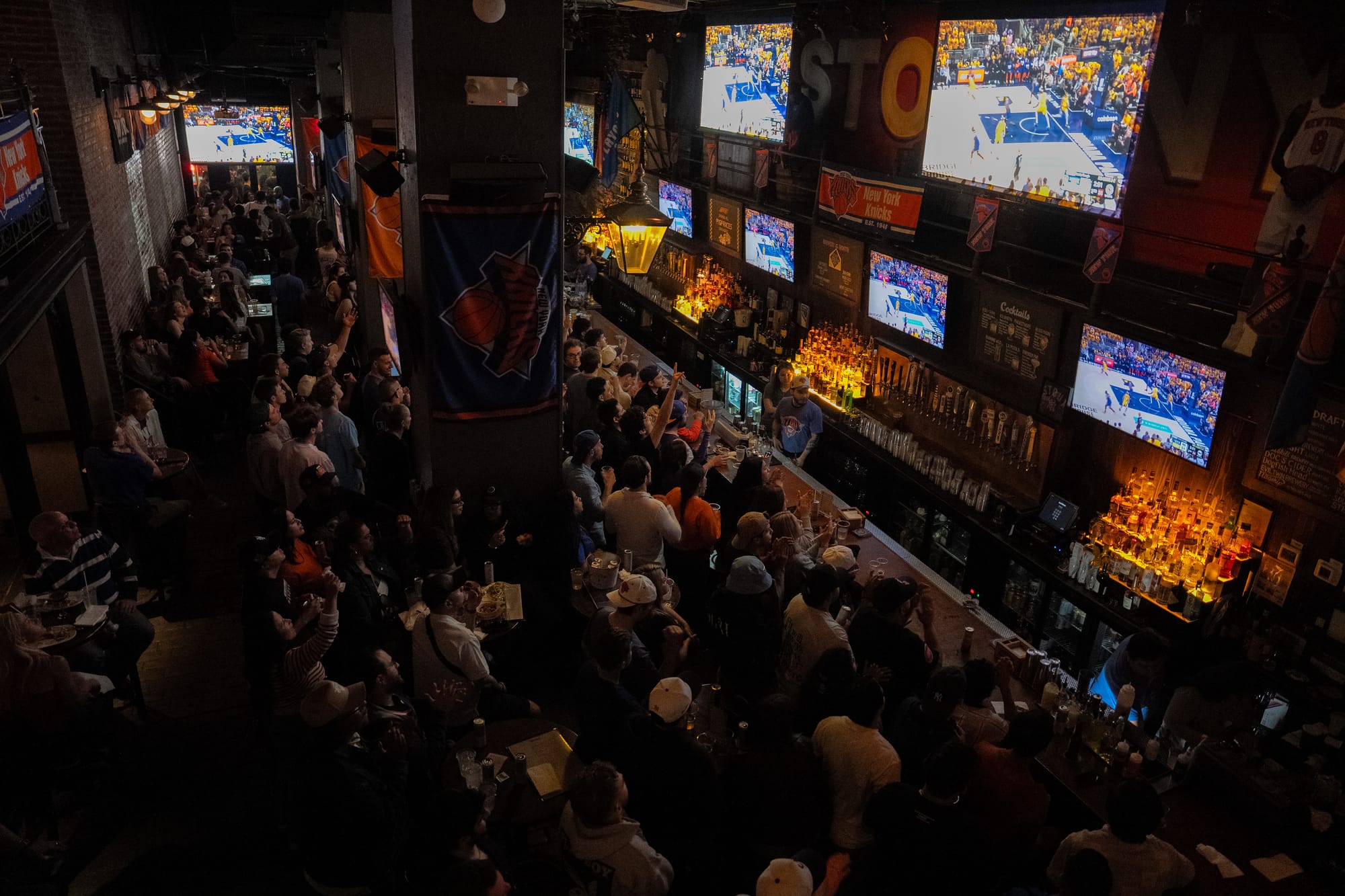
But 2026 will forever be thee summer the New York Knickerbockers won an NBA championship, ending a 53-year long drought. With each win, the Knicks drew closer to history, brought a city of nearly 8.6 million people with them, and brought us all closer to each other.
The only logical praxis was hope.
I joined this citywide mishpocha (Knickspocha?) as we gathered in bars, parks, and city streets to witness the Knicks together. How incredible it felt to be plugged into this web of communal suspense, electricity, and ultimately, jubilance, in which the city was linked (literally!) by the shared triumph of orange and blue, by replacing every greeting with “Knicks in [X],” by drunkenly singing Frank Sinatra’s “Theme From New York, New York” with strangers in the middle of the street. How incredible it was to experience a public bond that didn't originate with shared tragedy and trauma. I was reminded that this former Dutch trading outpost, once known as New Amsterdam, is a city of community, of possibility, of risk-taking, of immigrants, of magnificent, messy, heterogenous, densely concentrated humanity. I realized I was going to have to rouse myself and fight if I was going to remain in this place I love, doing the thing I love, the thing that makes life worth living in the first place.
At the same time, I was down to negative balances in all my accounts. Out of ideas, I turned to my community of Bluesky followers for help, having used every last dime, including all my savings, to weather the longest season of unemployment I’ve endured in 20 years. Until that point, I’d refrained from making the severity of my economic and professional circumstances too public because I’d held out hope that a stroke of meritorious luck would finally cease this miserable swan dive, and because I didn’t want to give those in media who’d welcomed the wokelash the satisfaction of knowing they’d succeeded in taking me out, too.
I was bowled over by the kindness, generosity, and compassion of my community of internet strangers and friends alike. They offered assistance, dignity, and appreciation for my writing. They sent messages telling me what I contribute to the world as a writer has meaning and value, which is no small thing when so much of the stock market, and thus the economy, is invested in a neocolonial water-and-electricity-gobbling technology that is supposed to render careers like mine obsolete.
Between the palpable euphoria the Knicks brought to the city and this vote of confidence, mostly from people on the internet who I’d never met before, I was finally able to quiet the depression gremlins that had been beckoning me toward Suicide Lane. In that quiet, I recalled something Wiley said when he was discussing An Archeology of Silence: “What you see in the show is a violent resistance to the downfall narrative. There’s a growth within the decay, and so that explains a lot of these landscapes that are sparkling with life.” Perhaps, out of the years of decay I’d experienced, there was a possibility for growth. Small rays of sunshine began to illuminate an escape route from the oubliette.
I have been a citizen of this country my entire life. But living in New York City made me an American. When you're tested here, and there's no one and nothing left to bet on but yourself, succeeding requires assuming the kind of delusional self confidence the world tends to ascribe to Americans as a people. I would know. Half my family is Dutch, and my whole life, America has been doing stuff that leaves them wondering if Americans have all simply lost our damn minds.
Speaking at the ticker tape parade celebrating the Knicks, our city’s young democratic socialist immigrant mayor, Zohran Kwame Mamdani, spoke to what made the moment so special.
“The Knicks did not just win for New York City—they won like New York City,” he said. “What is New York if not your back up against the wall, a dream that feels just out of reach, a rent payment you don't know how you will ever make? What is New York if not 99.6 percent of the world stacked against you? And who are New Yorkers if not people who hear those odds and smile? Who look at a .4 percent chance of success and ask, ‘Why're you giving me a head start?’”
That is the buoy of endorsement and belief I experienced when my community made sure I could pay bills and eat this summer without asking for anything in return. I emerged, in the waning days of summer, broke, but feeling like one of the luckiest people in the world, ready to reengage in criticism, and more resolute than ever in my belief that the world still needs it. I’m certainly not about to let a small group of emotionally stunted tech broligarchs John Henry me out of a living.
To those of you who have already bought memberships or otherwise helped keep me afloat in perilous times: thank you for the head start.
Now let’s get this show on the road!
[you may ask yourself] Well, How Did I Get Here?
Pocket Observatory: “Alright, let’s do this one last time.” by Meg Conley
Enshittification: Why Everything Suddenly Got Worse and What to Do About It by Cory Doctorow
Dolly Parton’s America from Jad Abumrad and Shima Oliaee
Outrageous Acts and Everyday Rebellions by Gloria Steinem
All About Love: New Visions by bell hooks
Hidden Brain: What Art Does For Your Brain
Race After Technology by Ruha Benjamin
Algorithms of Oppression: How Search Engines Reinforce Racism by Safiya U. Noble
Filterworld: How Algorithms Flattened Culture by Kyle Chayka
Thinking in Systems: A Primer by Donella H. Meadows
On Morrison by Namwali Serpell
The Paper (1994) dir. Ron Howard
Scene on Radio: The News by John Biewen and Chenjerai Kumanyika
Pop Syllabus With Christiana Mbakwe Medina: The State of Beauty Politics and What It All Means with Tressie McMillan Cottom
Disordered Attention: How We Look at Art and Performance Today by Claire Bishop
The Siren’s Call: How Attention Became the World’s Most Endangered Resource by Chris Hayes
I know there are those who will reach this point and wonder, Well, that’s all very nice and beautifully articulated, but what exactly is this? Behold! An FAQ:
So what exactly is this?
You can call it a blog, a newsletter, or a website. It is all of those. Soraya [dot] Press is a new publication dedicated to culture, politics, and ideas.
I’ll be publishing my own original work here on all things culture: film, TV, theatre, music, books, and visual art, in addition to personal essays and more political fare. I plan to publish other critics, especially critics of color, who don’t know how or don't care to write small, either. And I’ll host conversations with artists who work across a variety of forms.
It is also how I make my living. I would like to grow it into a thriving, sustainable enterprise, and I am experimenting with business models, including offering the work I publish here to news organizations for license or syndication.
Who is Soraya [dot] Press for?
It’s for anyone who enjoys reading, thinking, has eclectic tastes, and is seeking to understand the world a little bit better. If you believe, as I do, that criticism and art are necessary ingredients for a healthy liberal democracy, I suspect you’ll love it here. And if you don’t believe that, I think you’ll probably still enjoy reading or listening to me and others try to convince you. I try to write about art in a way that makes it pleasurable, interesting, and worthwhile to read, even if you haven’t seen the work I’m discussing.
Why should I support Soraya [dot] Press?
Well, I write for freedom, but I cannot write for free. So, on a basic level, buying a membership because you want to help me pay my rent and meet my other basic material needs is a perfectly valid reason, and one I very much appreciate! But it’s not the only reason.
I have ambitions for Soraya [dot] Press that extend beyond myself and its masthead, because I want to contribute to my beautiful community of Bed-Stuy and my beloved city of New York. That includes contributing to youth literacy efforts here. I plan to develop a free summer one-act playwriting workshop for youth called Camp Cornelia that culminates with a festival staging those works in my neighborhood amphitheatre. And I want to invest in creating space and opportunity for the many brilliant indie journalists and outlets I know so that we may better serve our communities and each other.
Plus, a paid membership means you become part of the commenting community here. This is not meant to be a one-way, top-down conversation, but an ongoing exchange. You also get photographic updates on my new feline familiars, Cio Cio-san and Radamés, known together as The Opera Kitties. And at some point, there will be cute, union-labor produced merch!
Ok, so what’s next?
Well, I can tell you I’m very excited for the pieces I’ve got planned. I’ll be writing on films such as NAZA, Your Mother Your Mother Your Mother, The Social Reckoning, Dune Pt. 3, and Children of Blood and Bone. You can also expect reviews of upcoming theater like America, Who Hurt You?, Cat on a Hot Tin Roof, Dolly: A True American Musical, and Prince’s Purple Rain. And given the K-shaped trajectory of the current economy and our historic levels of inequality, I'm also eager to dig into the fourth season of The Gilded Age. Oh, and I’m going to write about Nintendo’s remake of The Legend of Zelda: Ocarina of Time.
How do I subscribe? And what is the difference between a subscription and a membership?
You can subscribe by clicking here and entering your email address. You’ll get an email with a confirmation link (if you don’t see it in your main inbox, check your spam folder or if you have Gmail, your “Promotions” or “Update” tabs). Subscribing is free and will deliver new, non-paywalled articles straight to your inbox when they are published.
A membership is a paid subscription that gets you, at minimum, access to all articles, the full Soraya [dot] Press archive, commenting privileges, and my sincere gratitude.
What if I can’t afford a membership?
If you are an educator, a student, or need a pay-what-you-can membership, please send me a note. I got you.